
Criminal Cases in the Gilmer County Courts
Gilmer County uses two main court tracks. Circuit Court is the state's general-jurisdiction trial court and hears all felonies plus certain misdemeanors. Gilmer belongs to the Seventeenth Judicial Circuit with Braxton, Clay, and Webster Counties, so its circuit judges serve a four-county area. Magistrate Court hears misdemeanors and handles warrants, bail, initial appearances, and preliminary felony proceedings. A felony accusation can therefore begin in Gilmer County Magistrate Court before an indictment places it on the circuit docket.
The Circuit Clerk holds the official circuit case file. The Magistrate Clerk holds magistrate complaints, orders, and other lower-court papers. Municipal ordinance matters, where a town operates a municipal court, stay with that municipal clerk unless appealed. No official online Glenville municipal case search was found, so a statewide search should not be read as a full municipal index. The county clerk is not the criminal-court custodian.
Two Gilmer County Court Counters
The local justice offices form one courthouse-area cluster, yet official listings use two addresses. Circuit criminal files are at 10 Howard Street, Glenville, while the Magistrate Clerk is listed at 201 North Court Street. That split matters when a searcher needs the paper behind an online docket. Call the Circuit Clerk at 304-462-7241 for felony and circuit records. Call the Magistrate Clerk at 304-462-7812 for misdemeanor files, complaints, bond orders, and preliminary felony papers.
The Gilmer County Circuit Clerk page shows the circuit office and its posted hours. The captured office view below reflects the source used for those details.
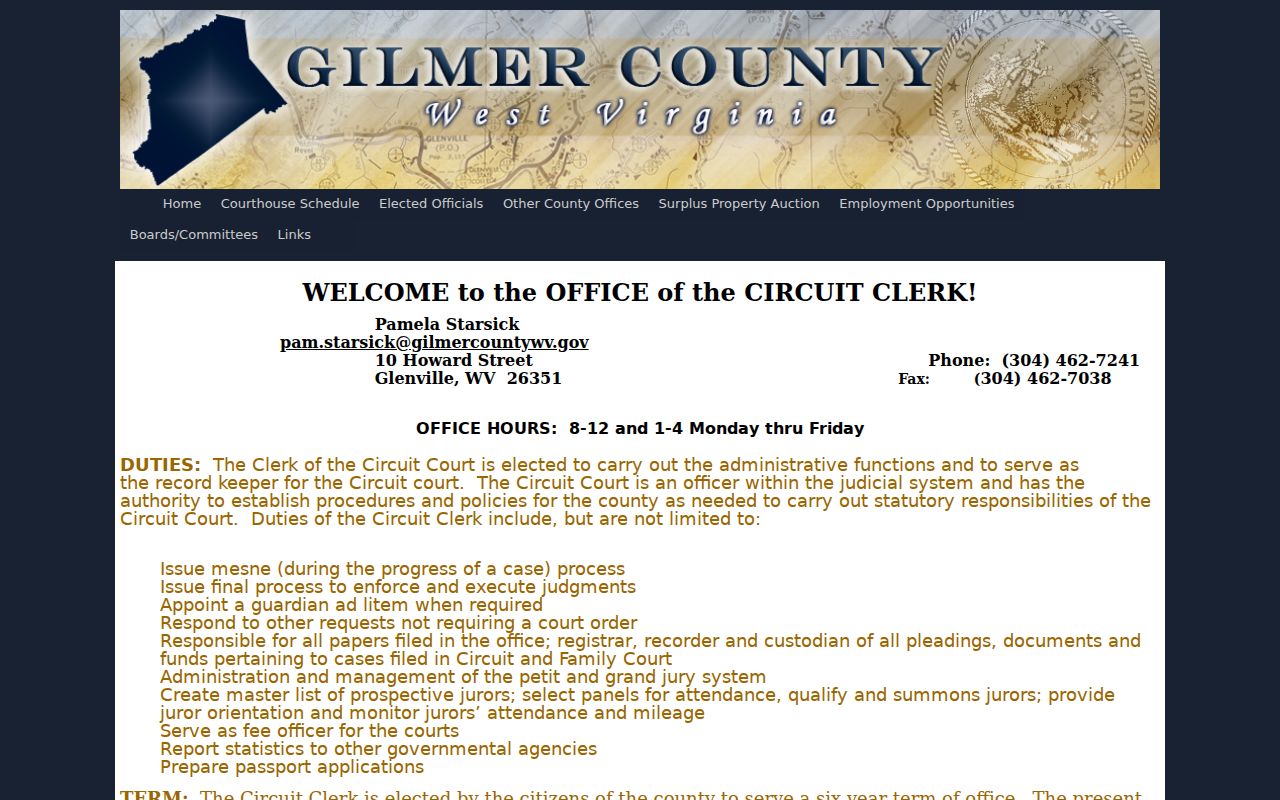
Its noon-to-one closure can affect a walk-in file request, since the posted weekday hours are 8 a.m. to noon and 1 to 4 p.m.
Gilmer County Circuit Clerk
10 Howard Street
Glenville, WV 26351
304-462-7241
Fax: 304-462-7038
Gilmer County Magistrate Clerk
201 North Court Street
Glenville, WV 26351
304-462-7812
Fax: 304-462-8582
How to Search Case Records
Use the portal that matches the case stage, then verify the result with the custodian. The free Magistrate Case Record Search provides docket data but no document images and caps results at 30. WVPASS provides public circuit records dating to 1999. Registration and searching are free; available documents cost $0.25 per page plus card processing.
- Open the official Magistrate Search for a misdemeanor or early felony, or WVPASS for a circuit case.
- Enter a party name or the full case number, then select Gilmer County and the criminal category when shown.
- Compare case IDs, filing dates, agencies, and separate charge counts before choosing a match.
- Read the event, bond, plea, disposition, and docket fields as separate parts of the case.
- Give the case ID to the correct clerk when requesting the complaint, final order, certified copy, or an older file.
The West Virginia Judiciary's Magistrate Search instructions explain the portal's reach and limits. This source image preserves the state guidance that frames a Gilmer County court search.
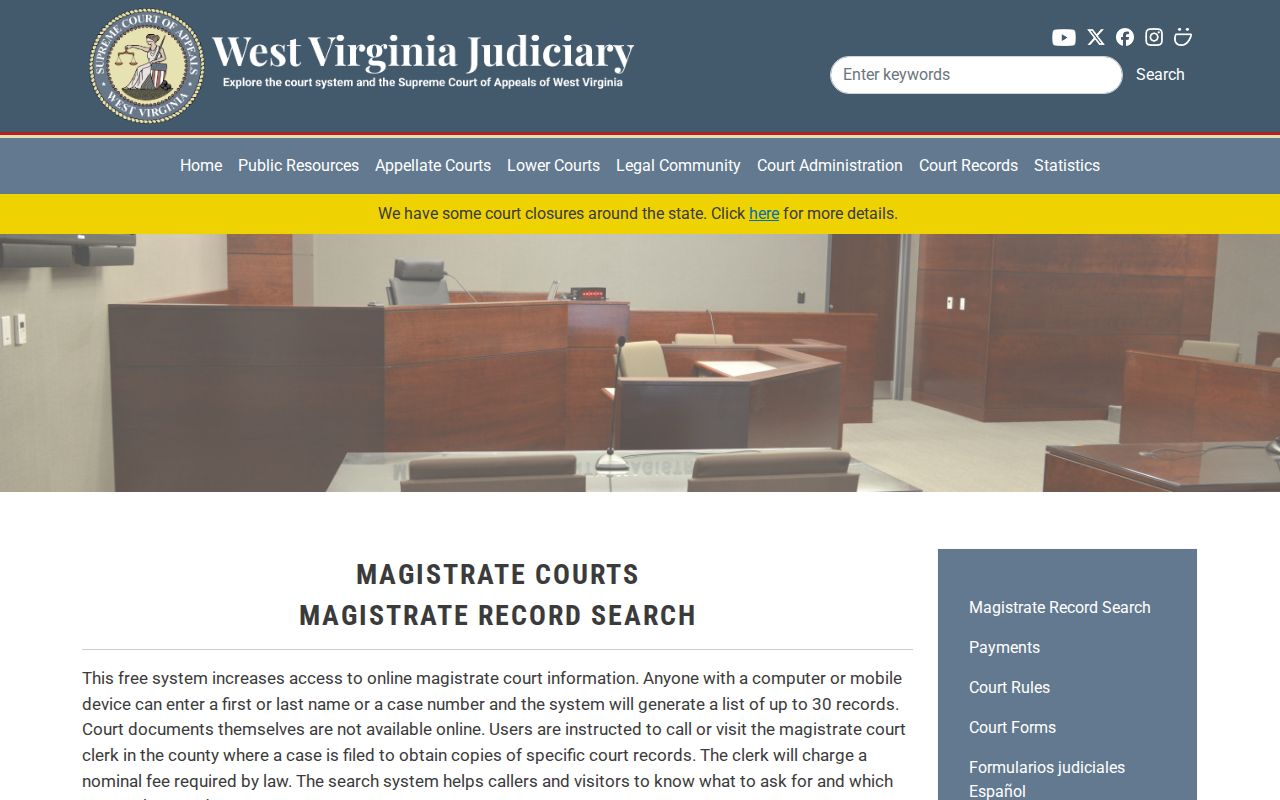
The instruction page is a useful checkpoint before relying on a name match because the Judiciary warns that results may not be complete.
| Field Label | Type | Required | Notes |
|---|---|---|---|
| First Name | Text | One name or case number | Useful for narrowing a common surname. |
| Last Name | Text | One name or case number | Try the full legal surname. |
| Case Number | Text | Alternative | A local format can resemble 25-M11M-00001. |
| County | Dropdown | For local filtering | Select Gilmer from all West Virginia counties. |
| Captcha and acceptance | Challenge | Yes | Terms must be accepted before results display. |
WVPASS Gilmer County Case Records
WVPASS changed remote access for this rural county. Gilmer's circuit e-filing began in 2018, statewide CourtPLUS deployment finished in 2024, and public WVPASS access opened in March 2025. The system reaches public circuit material back to 1999. That boundary is key. A missing older record calls for the Circuit Clerk, not the conclusion that the Gilmer County criminal case never existed.
The Judiciary's WVPASS launch notice describes the statewide circuit coverage and document access. The source capture below marks the point when Gilmer County circuit files became far easier to reach from outside Glenville.
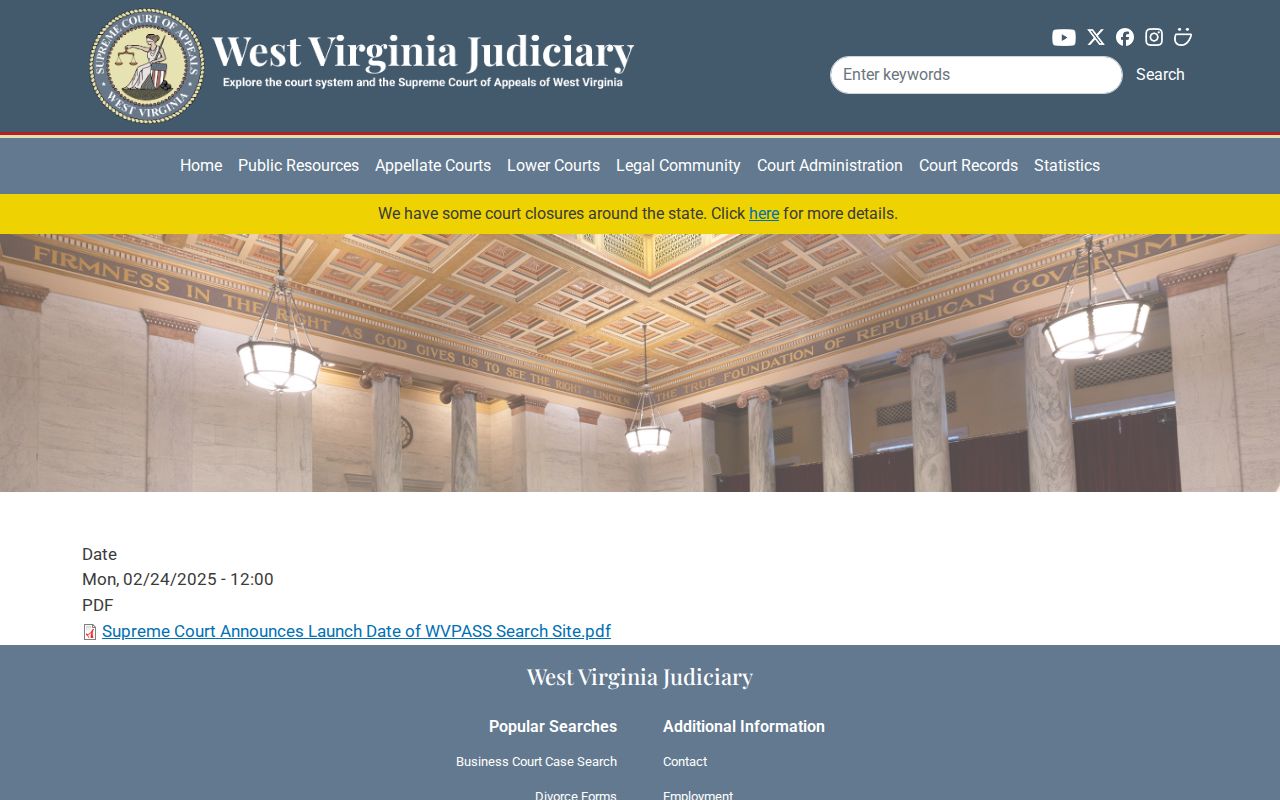
WVPASS is a public access layer, while the clerk still controls certification, archived material, and questions about an omitted document.
Note: A WVPASS case listing without a downloadable paper is a reason to call the clerk, not proof that the paper is confidential.
What the Case File Shows
A Gilmer County case file records prosecution rather than mere custody. It can show how an accusation was filed, how each count changed, what motions and hearings occurred, the plea or trial result, and the sentence. The final judgment or dismissal order is stronger evidence of outcome than a booking charge or a short portal label.
| Case Number and Court | Identifies the filing year, court level, county, class, and sequence. |
|---|---|
| Charging Document | Shows the complaint, indictment, or information and the statutes alleged. |
| Docket Entries | Lists filed papers, dates, codes, descriptions, and the filer. |
| Hearing Dates | Can include event type, time, room, judge, and closure reason. |
| Disposition and Judgment | Records the outcome of each count, such as conviction, dismissal, or acquittal. |
| Sentence and Conditions | Shows confinement, probation, restitution, and other court-ordered terms when public. |
The live Magistrate Case Record Search presents the searchable entry screen shown below. It leads to fielded docket information, not scanned complaints or orders.
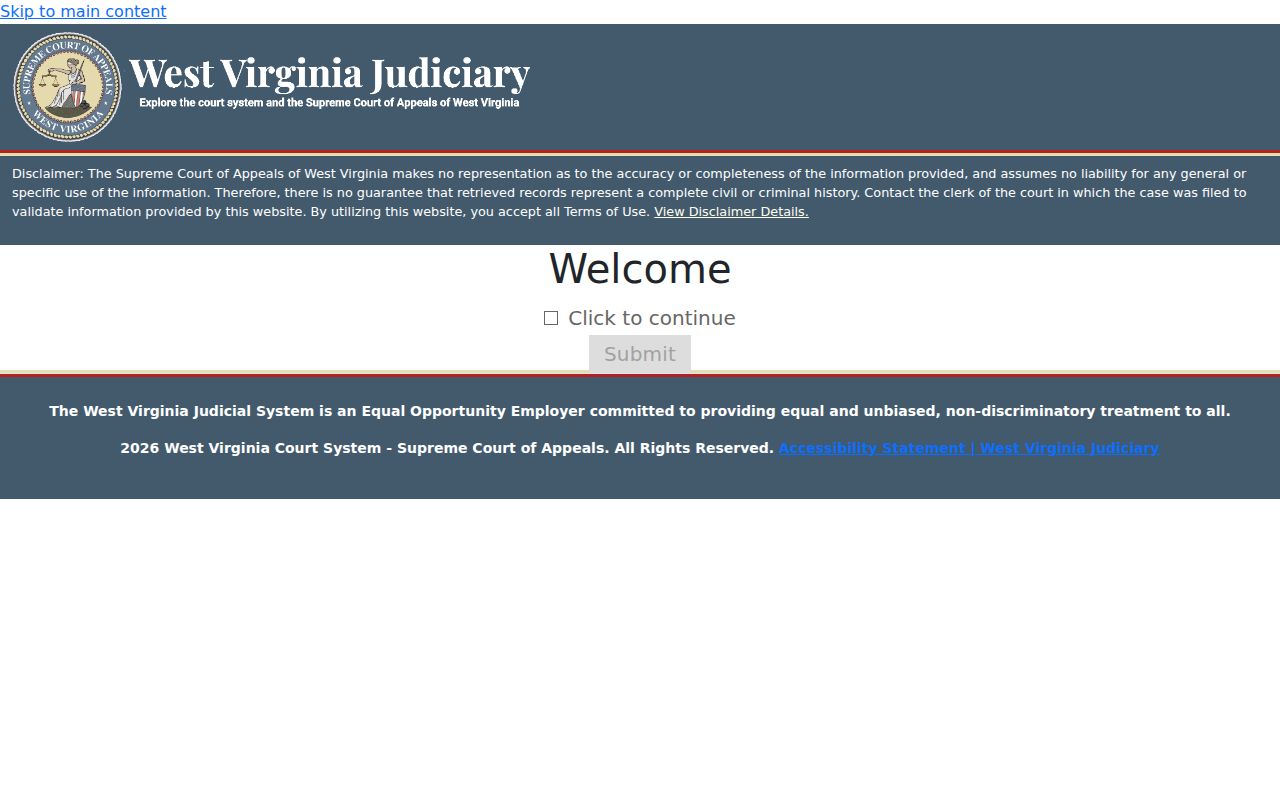
The screen helps locate a case ID that the Magistrate Clerk can then use to retrieve the source file.
Reading Gilmer County Case Outcomes
Each count needs its own reading. A plea is the accused person's formal response. A disposition is the court's outcome for that count. A dismissal ends a charge without conviction, while an acquittal is a not-guilty result after adjudication. Nolle prosequi means the prosecutor chose not to continue that charge at that time. Bond data only describes release security or conditions. It does not decide guilt.
- Initial appearance
- The prompt hearing after arrest that addresses rights, the charge, and bail.
- Indictment
- A grand jury's formal felony accusation, not a conviction.
- Disposition
- The result of a charge, such as conviction, dismissal, or acquittal.
- Capias
- Court process directing custody, often after a failure to appear or comply.
A booking charge may also differ from the count the Prosecuting Attorney files. The Gilmer County Prosecuting Attorney's official page identifies the office that prosecutes local misdemeanors and felonies and presents matters to the grand jury. The captured page below connects that office to the charging record.
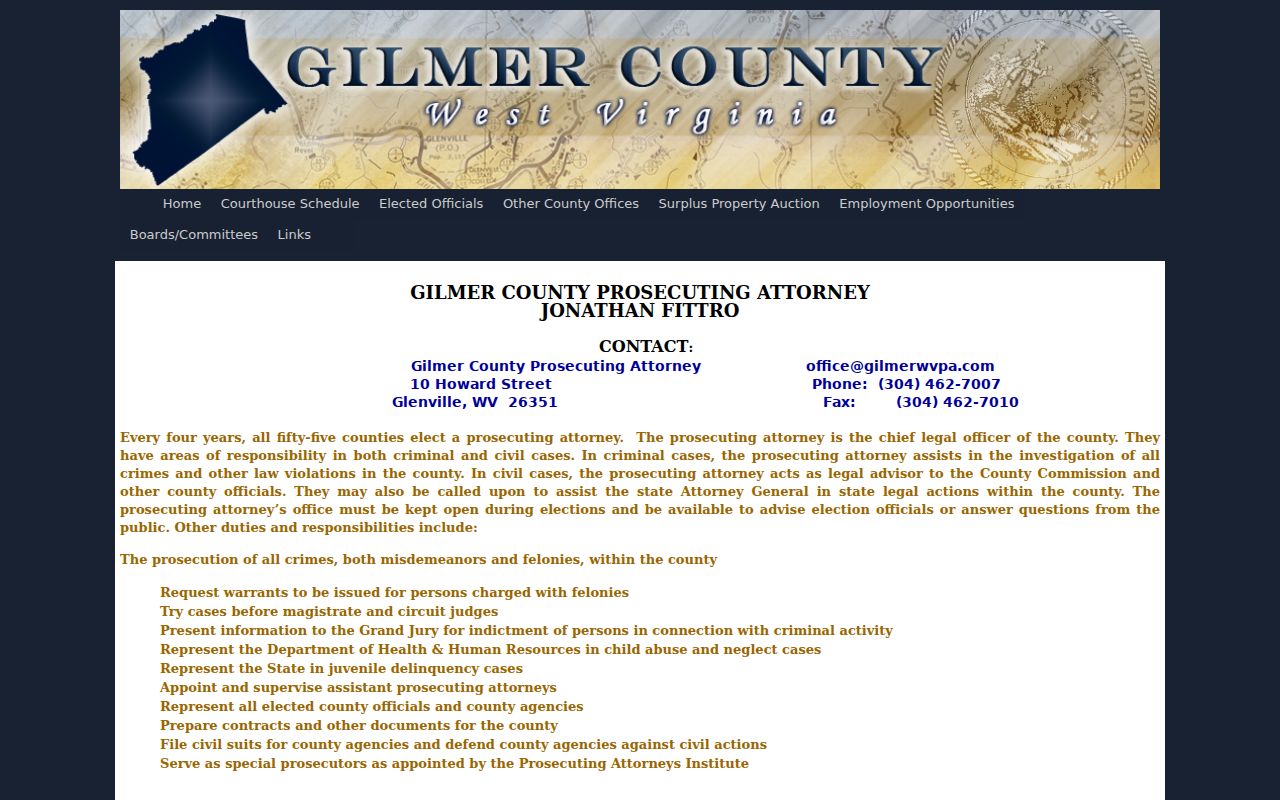
That role explains why the filed court counts can change from allegations recorded at the time of arrest.
Stages of a Criminal Case
A Gilmer County criminal case may begin with an arrest or summons and a complaint. The magistrate addresses rights, counsel, and bail. A misdemeanor can remain in Magistrate Court. A felony proceeds through preliminary steps and grand-jury review, then moves into Circuit Court after indictment. Circuit work includes discovery, motions, hearings, a negotiated plea or trial, judgment, sentence, and a possible appeal.
Case flow: Charges Filed › Arraignment › Pretrial › Plea or Trial › Disposition › Sentencing
The prosecuting office's public role includes requesting felony warrants and trying cases before magistrate and circuit judges. That office is at 10 Howard Street, 304-462-7007. Defense appointment follows the court's indigency process and does not run through the prosecutor.
Inspecting Gilmer County Case Files
When the online view is not enough, an inspection request may be oral or written and should identify the record with reasonable detail. Clerk staff retrieve the file. Inspection may occur in a supervised area, and reasonable controls can protect the paper. General research cannot simply be refused, but the clerk may guard the record and apply lawful copy charges.
The Gilmer County Circuit Clerk is Pamela Starsick at 10 Howard Street, Glenville, WV 26351. The published email is pam.starsick@gilmercountywv.gov. Call before a trip about security, photography, device rules, accessibility, and current holiday hours because the researched official sources did not establish one universal policy for those points.
Note: Give the clerk a case number, party name, court level, and likely filing year to make a file request reasonably specific.
Older Gilmer County Criminal Cases
WVPASS coverage begins with public circuit records dating to 1999. A Gilmer County criminal case from an earlier year therefore needs a clerk-assisted search. Give the Circuit Clerk the party name, likely filing span, charge type if known, and any old case number. Staff, rather than visitors, retrieve the court file and can set reasonable rules for supervised review.
Older magistrate material and a circuit archive do not become statewide repository histories. They remain court records tied to a specific proceeding. For a reliable outcome, ask for the final judgment, dismissal order, or sentencing order rather than relying on a handwritten index or an old arrest reference. Copy and certification costs should be confirmed with the clerk because no complete Gilmer County fee schedule was established in the official research.
Access & Restrictions
West Virginia Code §51-4-2 supports public inspection and copying of court papers unless another law or order restricts access. That public rule does not expose every field. Sealed and expunged cases, juvenile material, protected victim information, private identifiers, and records covered by a specific confidentiality rule can remain unavailable or redacted.
The West Virginia Freedom of Information Act does not override those limits. Court staff can explain whether a public index exists, but they cannot disclose a sealed file. If a record expected in Gilmer County does not appear, confirm the court level, spelling, date, and WVPASS coverage. Then ask the owning clerk whether the issue is an archive, a delayed entry, a restricted record, or simply no matching case. Broader county record routes are set out in the Gilmer County criminal history overview.